
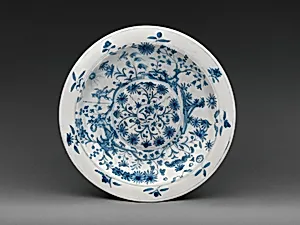
Dish
ca. 1575–87
Medium
Soft-paste porcelain decorated in underglaze blue
Dimensions
Overall: 1 5/8 × 11 1/2 in. (4.1 × 29.2 cm)
Classification
Ceramics-Porcelain
Culture
Italian, Florence
Department
European Sculpture and Decorative Arts
Museum
Metropolitan Museum of Art, New York, NY
Credit
Gift of Mrs. Joseph V. McMullen, and Fletcher Fund, 1946
Accession Number
46.114
Rights
Public Domain
Tags
Art Historical Context
This elegant dish from the Medici Porcelain Manufactory in, Italy, dates to around 1575–87 and one of Europe's earliest forays into porcelain production. Crafted during the Renaissance under the patronage of Grand Duke Francesco I de', the shallow plate measures just 1 5/8 × 11 1/2 inches, perfect for serving delicate confections or displaying as a collector's treasure. Its soft-paste porcelain body—made from a mixture of clay, sand, and ground glass rather than true kaolin—is decorated in underglaze blue with floral motifs, evoking the luxurious blue-and-white wares imported from Ming China that captivated European courts. The Medici factory, active for only about a dozen years, represented a bold alchemical experiment to break China's porcelain monopoly. Artisans fired the soft-paste at lower temperatures, achieving a creamy translucency prized by collectors, though it was more fragile than later hard-paste formulas. The underglaze blue technique, applied before glazing and firing, ensured vibrant, durable colors that mimicked Eastern elegance while showcasing Italian ingenuity. Today, housed in the Metropolitan Museum of Art's European Sculpture and Decorative Arts department (gift of Mrs. Joseph V. McMullen and Fletcher Fund, 1946), this rare survivor highlights Florence's role as a hub of artistic innovation, blending cultural exchange with Renaissance ambition. A true gem for admirers of ceramics history!