
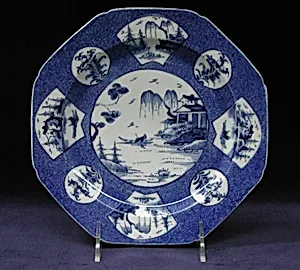
Dish
ca. 1760–65
Medium
Soft-paste porcelain
Dimensions
Diameter: 8 5/8 in. (21.9 cm)
Classification
Ceramics-Porcelain
Culture
British, Bow, London
Department
European Sculpture and Decorative Arts
Museum
Metropolitan Museum of Art, New York, NY
Credit
The Hans Syz Collection, Gift of Stephan B. Syz and John D. Syz, 1995
Accession Number
1995.268.13
Rights
Public Domain
Tags
Art Historical Context
This elegant dish, crafted around 1760–65 at the Bow Porcelain Factory in London, exemplifies the early achievements of British porcelain production. As one of England’s pioneering manufacturers, Bow specialized in soft-paste porcelain, a material developed to mimic the prized Chinese imports while adapting to local resources and techniques. The medium’s creamy texture and subtle translucency allowed for delicate painted decoration, here featuring charming scenes of houses, trees, and boats that reflect the period’s taste for pastoral and riverine landscapes. Soft-paste porcelain represented a significant technological and artistic milestone in 18th-century Europe, bridging the gap before true hard-paste formulas were mastered in Britain. Bow’s output often combined hand-painted motifs with influences from both Asian ceramics and contemporary European prints, making pieces like this dish both functional tableware and objects of refined display. Its modest scale—roughly eight and a half inches across—suggests it was designed for everyday elegance in Georgian households. Today, this work forms part of the Metropolitan Museum’s Hans Syz Collection, highlighting the enduring appeal of English porcelain as both craft and cultural artifact.
About the Artist
Bow Porcelain Factory · 1747–1776
The Bow Porcelain Factory, established around 1747 in East London near Bow and relocated by 1749 to "New Canton" east of the River Lea, emerged as one of England's pioneering soft-paste porcelain manufacturers, rivaling the Chelsea factory. Founded by merchant Edward Heylyn and Irish painter Thomas Frye, who secured key patents in 1744 and 1748–49 for using Cherokee kaolin and bone ash, the factor...