
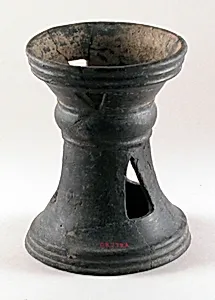
Dish
Unknown Artist
ca. 550–500 BCE
Medium
Terracotta
Dimensions
Height (w/ handles): 5 1/8 in. (13 cm) Diameter: 8 1/2 in. (21.6 cm)
Classification
Vases
Culture & Period
Etruscan · Archaic
Department
Greek and Roman Art
Museum
Metropolitan Museum of Art, New York, NY
Credit
Purchase, 1896
Accession Number
96.9.54b
Rights
Public Domain
Art Historical Context
This elegant terracotta dish, crafted by an unknown Etruscan artist around 550–500 BCE, the Archaic period's vibrant pottery tradition in ancient Italy. Belonging to the Etruscan—a sophisticated pre-Roman civilization centered in central Italy—the vessel measures 8 1/2 inches in diameter with handles adding to its 5 1/8-inch height, making it a practical yet refined piece likely used for serving food or liquids during banquets or rituals. Etruscans, heavily influenced by Greek imports, adapted these forms to suit their own tastes, blending functionality with subtle artistry. Terracotta, or fired clay, was a hallmark medium for Etruscan vases, valued for its durability and ability to hold intricate shapes when wheel-thrown and kiln-fired. This dish's shallow bowl design with handles reflects the period's emphasis on symmetry and everyday utility, hinting at the Etruscans' prosperous urban life and love of communal feasting. Acquired by the Metropolitan Museum of Art through purchase in 1896, it offers a window into a culture that bridged Greek innovation and Roman foundations. Today, this unadorned yet poised artifact invites us to ponder the daily rhythms of Archaic Etruria, where even simple wares embodied cultural pride.