
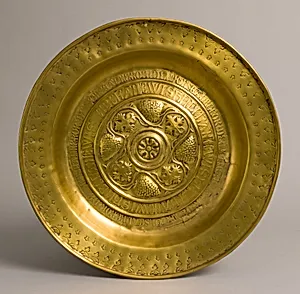
Dish
Unknown Artist
early 16th century
Medium
Brass
Dimensions
Overall: 16 1/8 x 1 3/4 in. (41 x 4.5 cm)
Classification
Metalwork-Brass
Culture
German
Department
Medieval Art
Museum
Metropolitan Museum of Art, New York, NY
Credit
Gift of W. L. Hildburgh, 1932
Accession Number
32.64.31
Rights
Public Domain
Tags
Art Historical Context
This elegant brass dish, crafted by an unknown German artist in the 16th century, the fine metalwork traditions of the late medieval and early Renaissance periods. Measuring 16 1/8 x 1 3/4 inches (41 x 4.5 cm), it was likely designed for both practical use—such as serving food—and decorative display in affluent households. The choice of brass, a durable and malleable alloy of copper and zinc, allowed artisans to create intricate designs through techniques like engraving or repoussé, showcasing their skill in transforming everyday objects into art. A key feature is its decoration centered on grapes, a motif symbolizing abundance, fertility, and the vine's cultural resonance in German regions known for viticulture and wine production. During this era, as the Renaissance influenced Northern Europe, German metalworkers blended Gothic detailing with emerging humanistic themes, making pieces like this dish prized possessions that reflected wealth and piety. Generously donated to the Metropolitan Museum of Art in 1932 by W. L. Hildburgh, this dish now resides in the Medieval Art department, offering visitors a tangible glimpse into 16th-century craftsmanship and daily life. Its survival highlights the enduring appeal of such functional yet beautiful artifacts.