
Dish
Unknown Artist
Medium
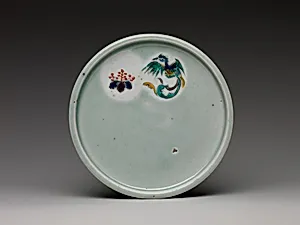
Porcelain with celadon glaze and enamels (Hizen ware)
Dimensions
H. 7/8 in. (2.2 cm); Diam. 5 3/4 in. (14.6 cm)
Classification
Ceramics
Culture & Period
Japan · early Edo period (1615–1868)
Department
Asian Art
Museum
Metropolitan Museum of Art, New York, NY
Credit
The Harry G. C. Packard Collection of Asian Art, Gift of Harry G. C. Packard, and Purchase, Fletcher, Rogers, Harris Brisbane Dick, and Louis V. Bell Funds, Joseph Pulitzer Bequest, and The Annenberg Fund Inc. Gift, 1975
Accession Number
1975.268.513
Rights
Public Domain
Art Historical Context
This delicate porcelain dish, a fine example of Hizen ware from Japan's early Edo period (161–1868), exemplifies era's blossoming ceramic artistry. Measuring just 7/8 inch high and 5 3/4 inches in diameter, its shallow form was ideal for serving sweets, sauces, or small morsels in intimate settings like the tea ceremony or daily meals. Produced in the kilns of Hizen provincemodern-day Saga), these wares marked Japan's mastery of porcelain technology, imported from Korea and refined to rival Chinese imports. The dish's celadon glaze—a signature pale green hue achieved through iron oxide in a reducing kiln atmosphere—evokes the elegance of Song dynasty Chinese ceramics, while overglaze enamels add vibrant, intricate decorations fired at lower temperatures for colorful motifs. This technique, perfected in the 17th century, allowed Hizen potters to innovate with vivid patterns, blending functionality and beauty during the peaceful Tokugawa shogunate, when domestic demand and export to Europe surged. Now part of the Metropolitan Museum of Art's Asian Art collection, thanks to the Harry G. C. Packard Collection, this anonymous masterpiece highlights Japan's ceramic golden age, inviting us to appreciate the subtle sophistication of everyday objects turned art.