
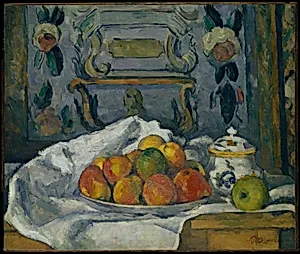
Dish of Apples
ca. 1876–77
Medium
Oil on canvas
Dimensions
18 1/8 x 21 3/4 in. (46 x 55.2 cm)
Classification
Paintings
Department
European Paintings
Museum
Metropolitan Museum of Art, New York, NY
Credit
The Walter H. and Leonore Annenberg Collection, Gift of Walter H. and Leonore Annenberg, 1997, Bequest of Walter H. Annenberg, 2002
Accession Number
1997.60.1
Rights
Public Domain
Tags
Art Historical Context
Paul Cézanne's *Dish of Apples* (ca. 1876–77) is a quintessential still life that captures the artist's fascination with everyday objects, rendered in oil on canvas measuring 18 1/8 x 21 3/4 inches. Housed in the Metropolitan Museum of Art as part of The Walter H. and Leonoreenberg Collection, this modest yet monumental work showcases a simple arrangement of apples in a dish, bathed in soft, diffused light. Cézanne, a pivotal figure in Post-Impressionism, elevates humble fruits to heroic status, transforming a domestic scene into a profound study of form and space. Painted in the late 1870s, during a period when Cézanne was distancing himself from the fleeting impressions of his contemporaries like Monet, this piece reflects his revolutionary approach. Rather than prioritizing optical realism, he builds volume and structure through deliberate brushstrokes and subtle color modulations—greens, reds, and earthy tones that construct a tangible, almost sculptural presence. His technique anticipates Cubism, as objects appear solid yet multifaceted, challenging the flatness of traditional still lifes. This work underscores Cézanne's enduring legacy: his apple still lifes became synonymous with modern art, proving that profound beauty lies in the ordinary. Visitors will appreciate how it invites contemplation of perception itself, a timeless invitation to see the world anew.
About the Artist
Paul Cézanne · 1839–1906
Paul Cézanne (1839-1906) stands as one of the most influential figures in the history of modern art, often called the "Father of Modern Art" for his revolutionary approach to form, color, and pictorial space. Born in Aix-en-Provence to a wealthy banker who discouraged artistic pursuits, Cézanne rejected a legal career to pursue painting, though he remained financially dependent on his family until...