
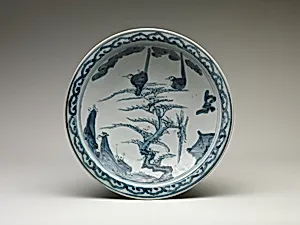
松に鳥文皿 肥前焼・初期伊万里様式|Dish with Birds on a Pine
Unknown Artist
ca. 1624–43
Medium
Porcelain with underglaze blue (Hizen ware, early Imari type)
Dimensions
Diam. 15 5/8 in. (39.7 cm); H. 4 3/8 in. (11.1 cm)
Classification
Ceramics
Culture & Period
Japan · Edo period (1615–1868)
Department
Asian Art
Museum
Metropolitan Museum of Art, New York, NY
Credit
The Harry G. C. Packard Collection of Asian Art, Gift of Harry G. C. Packard, and Purchase, Fletcher, Rogers, Harris Brisbane Dick, and Louis V. Bell Funds, Joseph Pulitzer Bequest, and The Annenberg Fund Inc. Gift, 1975
Accession Number
1975.268.470
Rights
Public Domain
Tags
Art Historical Context
This elegant dish, titled *Dish with Birds on a* (松に鳥文皿), exemplifies early Imari porcelain from Japan's Hizen kilns during the Edo period (ca 1624–43). Crafted in porcelain with underglaze decoration—a technique where cobalt pigment is painted beneath a transparent glaze before high-temperature firing—the piece features birds perched gracefully among pine branches. Measuring an impressive 15⅝ inches (39.7 cm) in diameter and 4⅜ inches (11.1 cm) high, it was likely used for serving food or as a decorative charger, showcasing the kilns' rapid mastery of this imported Chinese-inspired method. Hizen ware, produced in what is now Saga Prefecture, marked Japan's entry into global porcelain trade in the early 17th century. Early Imari styles like this one were among the first exported to Europe via Dutch traders, sparking a craze for "fine china" that influenced Western ceramics. The underglaze blue yields enduring, vivid designs resistant to wear, highlighting technical innovation amid Japan's isolationist policies. Symbolically, the pine tree evokes longevity and resilience in Japanese culture, while birds add vitality and harmony with nature. Part of The Metropolitan Museum of Art's Harry G. C. Packard Collection, this dish offers a window into Edo-era artistry, blending functionality with poetic beauty.