
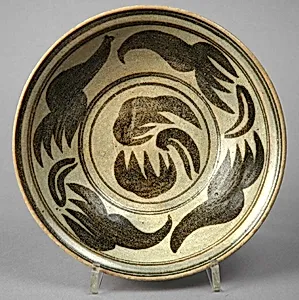
Dish with Floral Design
Unknown Artist
late 14th–early 16th century
Medium
Stoneware with underglaze iron-oxide design
Dimensions
H. 2 1/8 in. (5.4 cm) Diam. of rim: 8 11/16 in. (22.1 cm) Diam. of foot: 5 1/4 in. (13.3 cm)
Classification
Ceramics
Culture
Thailand (Kalong)
Department
Asian Art
Museum
Metropolitan Museum of Art, New York, NY
Credit
Gift of Marie-Hélène and Guy Weill, 1995
Accession Number
1995.579
Rights
Public Domain
Art Historical Context
This elegant *Dish with Floral Design*, crafted in Thailand's Kalong tradition during the late 14th to early 16th century, the sophistication of Southeast Asian ceramics from the Sukhothai period. Produced at kiln sites in northern Thailand, Kalong stoneware was prized for its durability and refined aesthetics, often exported across Asia. The dish's subtle floral motifs, rendered in underglaze iron-oxide, bloom gracefully across its shallow form, evoking the natural beauty of the region's landscapes. The medium—stoneware decorated with iron oxide applied beneath a transparent glaze—highlights innovative techniques of the era. When fired in kilns reaching over 1,200°C, the iron oxide transforms into rich reddish-brown hues, creating a striking contrast against the grayish body. This underglaze method ensured designs remained vivid and resistant to wear, blending functionality with artistry in everyday vessels like this one, used for serving food or as ceremonial ware. Now part of the Metropolitan Museum of Art's Asian Art collection (gift of Marie-Hélène and Guy Weill, 1995), this dish offers a window into Thailand's vibrant ceramic heritage, where floral symbolism celebrated abundance and harmony. Measuring just over 8 inches across, it's a testament to the anonymous potters' skill in turning clay into timeless beauty.