
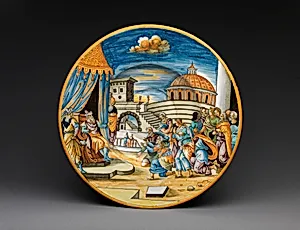
Dish with Joseph and His Brothers
ca. 1630–45
Medium
Faïence (tin-glazed earthenware)
Dimensions
Overall: 2 1/8 × 17 1/8 in. (5.4 × 43.5 cm)
Classification
Ceramics-Pottery
Culture
French, Nevers
Department
European Sculpture and Decorative Arts
Museum
Metropolitan Museum of Art, New York, NY
Credit
Gift of J. Pierpont Morgan, 1917
Accession Number
17.190.1804
Rights
Public Domain
Tags
Art Historical Context
This exquisite *Dish with Joseph and His Brothers*, around 1630–45 by Antoinerade and Bernard Salomon in Nevers, France, exemplifies the golden age of French faience production. Crafted from tin-glazed earthenware, large, shallow dish—measuring over 17 inches across—was likely designed for both display and serving, showcasing vibrant polychrome glazes that brought biblical narratives to life in domestic settings. Nevers faience workshops were renowned for their technical mastery, achieving brilliant blues, yellows, and greens through tin-opacified glazes fired at high temperatures, rivaling Italian maiolica influences while developing a distinctly French flair. The central scene depicts the dramatic Old Testament story from Genesis, where Joseph confronts his brothers amid a bustling crowd and architectural backdrop—evident in the tags noting buildings and crowds. This moral tale of betrayal, forgiveness, and providence resonated deeply in 17th-century Catholic France, where such ceramics adorned bourgeois homes as affordable yet sophisticated religious art. A gift to the Metropolitan Museum of Art from J. Pierpont Morgan in 1917, this piece highlights Nevers' role in democratizing fine art through pottery, blending storytelling with technical innovation for everyday wonder.