
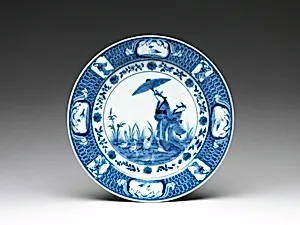
Dish with Parasol Ladies
ca. 1735–40
Medium
Porcelain painted with cobalt blue under and colored enamels over transparent glaze (Hizen ware; Imari type)
Dimensions
H. 1 5/16 in. (3.3 cm); Diam. 10 1/2 in. (26.7 cm)
Classification
Ceramics
Culture & Period
Japan · Edo period (1615–1868)
Department
Asian Art
Museum
Metropolitan Museum of Art, New York, NY
Credit
Dr. and Mrs. Roger G. Gerry Collection, Bequest of Dr. and Mrs. Roger G. Gerry, 2000
Accession Number
2002.447.123
Rights
Public Domain
Tags
Art Historical Context
This elegant porcelain dish, created around 5–40 by Dutch Cornelis Pronk, exemplifies the refined artistry of Japan’s Edo period. Produced in Hizen ware of the Imari type, it features delicate women holding parasols alongside graceful birds, rendered through a sophisticated layering of cobalt blue under the glaze and vibrant colored enamels above. The transparent glaze enhances the luminous quality of the surface, highlighting the intricate details that made such export wares highly prized in both Asia and Europe. Pronk’s designs, often commissioned for international trade, were executed by skilled Japanese potters in the Arita region. This fusion of European-inspired figural motifs with traditional Japanese porcelain techniques reflects the dynamic cultural exchanges of the eighteenth century. The dish’s shallow form and balanced composition make it both functional and decorative, showcasing the technical mastery of underglaze and overglaze painting that defined Imari production. Measuring just over ten inches in diameter, the piece belongs to the Metropolitan Museum of Art’s Asian Art collection. It offers visitors a window into the Edo period’s blend of local craftsmanship and global artistic dialogue, where everyday scenes of women and nature were transformed into enduring works of ceramic art.
About the Artist
Cornelis Pronk · 1691–1759
Comment on works: Portraits; Views; Landscapes; Interiors