
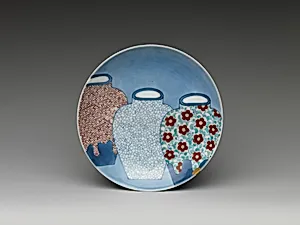
色絵三壺文小皿|Dish with Three Jars
Unknown Artist
1680–90s
Medium
Porcelain with underglaze blue and overglaze polychrome enamels (Hizen ware, Nabeshima type)
Dimensions
H. 1 5/8 in. (4.1 cm); Diam. 6 in. (15.2 cm)
Classification
Ceramics
Culture & Period
Japan · Edo period (1615–1868)
Department
Asian Art
Museum
Metropolitan Museum of Art, New York, NY
Credit
The Harry G. C. Packard Collection of Asian Art, Gift of Harry G. C. Packard, and Purchase, Fletcher, Rogers, Harris Brisbane Dick, and Louis V. Bell Funds, Joseph Pulitzer Bequest, and The Annenberg Fund Inc. Gift, 1975
Accession Number
1975.268.563
Rights
Public Domain
Tags
Art Historical Context
This exquisite small dish, created in Japan during the late 17th century, exemplifies the refined artistry of Nabeshima ware, a prestigious type of Hizen porcelain produced under the patronage of the Nabeshima clan in what is now Saga. Dating to the 0s–90 in the Edo period, the piece reflects a time when Japanese ceramics reached new heights of technical sophistication, blending functionality with decorative elegance for households. The dish’s surface features a charming motif of three jars rendered in underglaze blue and overglaze polychrome enamels. This meticulous technique—iring the porcelain first with cobalt blue, then applying vibrant enamels and refiring at lower temperatures—allowed for rich color contrasts and delicate details. Nabeshima wares like this were rarely exported, instead serving as high-status tableware or gifts, underscoring their cultural role in Edo-period Japan. Measuring just over six inches across, the compact form highlights the precision and restraint characteristic of Nabeshima production. Today it resides in the Metropolitan Museum’s Asian Art collection, offering visitors a glimpse into the harmonious blend of utility and beauty that defined Japanese ceramic traditions.