
Disk
Unknown Artist
6th–7th century
Medium
Gilded copper, silvered copper, shell inlay
Dimensions
Diameter 6-1/8 in. (15.5 cm)
Classification
Metal-Ornaments
Culture
Moche
Department
Arts of Africa, Oceania, and the Americas
Museum
Metropolitan Museum of Art, New York, NY
Credit
Gift of Jane Costello Goldberg, from the Collection of Arnold I. Goldberg, 1980
Accession Number
1982.392.8
Rights
Public Domain
Art Historical Context
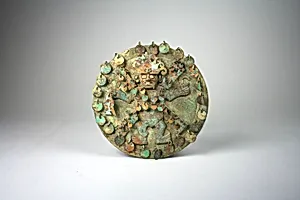
This exquisite gilded copper disk, crafted by an unknown Moche artist in the 6th–7th century, hails from the ancient Moche culture of Peru's northern coast. The Moche, flourishing between 100–700 CE, were master artisans renowned for their sophisticated metalwork, ceramics, and monumental architecture. Ornaments like this disk likely served as elite pectorals, earspools, or ritual adornments, symbolizing status and spiritual power in a society where metallurgy reflected divine favor and warrior prowess. Measuring just over 6 inches in diameter, the disk showcases advanced techniques: sheets of copper gilded with gold and silvered for a luminous effect, enhanced by intricate shell inlays that catch the light. These methods highlight the Moche's innovative use of local resources—copper from Andean mines, shells from the Pacific coast—demonstrating depletion gilding and false filigree for opulent shine without vast precious metals. As a rare survivor of perishable burial goods, this piece offers a window into Moche cosmology and craftsmanship, now preserved at The Metropolitan Museum of Art. Visitors, imagine it gleaming on a lord's chest during ceremonies honoring sea gods or harvests— a testament to a civilization's enduring brilliance.