
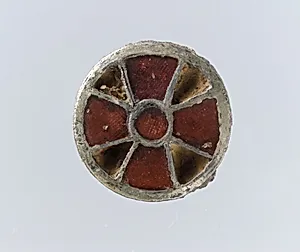
Disk Brooch
Unknown Artist
6th century
Medium
Silver-gilt on iron core, metal foil, inlaid garnet or paste
Dimensions
Overall: 7/8 x 1/4 in. (2.2 x 0.6 cm)
Classification
Metalwork-Silver
Culture
Frankish
Department
Medieval Art
Museum
Metropolitan Museum of Art, New York, NY
Credit
Gift of J. Pierpont Morgan, 1917
Accession Number
17.191.11
Rights
Public Domain
Art Historical Context
This exquisite Disk Brooch, crafted by an unknown Frankish artisan in the 6th, exemplifies the masterful metalwork of early Medieval Europe. Measuring just 7/8 x 1/4 inches (2.2 x 0.6 cm), this jewel was likely used to fasten cloaks or garments, serving both practical and decorative purposes. Housed in the Metropolitan Museum of Art's Art Department, it entered the collection as a gift from J Pierpont Morgan in 7, highlighting its enduring allure. The brooch's construction reveals sophisticated techniques: a sturdy iron core sheathed in silver-gilt—silver coated with a thin layer of gold for a luxurious sheen—adorned with metal foil and inlaid garnets or paste (imitation gems). This garnet inlay, a hallmark of Frankish jewelry during the Merovingian era, mimicked precious stones through precise cloisonné-like settings, showcasing skilled lapidary work and access to trade networks spanning Europe and beyond. Such opulence signaled wealth and status among the Frankish elite, who dominated Gaul (modern France) after the fall of Rome. As a survivor of the turbulent Migration Period, this brooch offers a glimpse into daily life and artistic innovation, blending Germanic traditions with Roman influences in compact, radiant form. Visitors will appreciate its delicate beauty up close, a testament to the artistry of an age often overshadowed by grand cathedrals.