
Disk Brooch
Unknown Artist
7th century
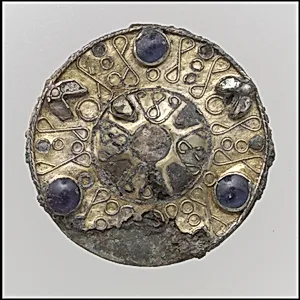
Medium
Silver over copper alloy, paste cabochons, iron pin, gold setting, seed pearl
Dimensions
Overall: 1 9/16 x 1/2 in. (4 x 1.2 cm)
Classification
Metalwork-Gold
Culture
Frankish
Department
Medieval Art
Museum
Metropolitan Museum of Art, New York, NY
Credit
Gift of J. Pierpont Morgan, 1917
Accession Number
17.191.136
Rights
Public Domain
Art Historical Context
This exquisite Disk Brooch, crafted by an unknown Frankish artisan in 7th century, the refined metalworking traditions of early medieval Europe during the Merovingian period. Hailing from the Frankish culture that dominated much of modern-day France and Germany, such brooches were essential accessories, used to fasten cloaks or while signaling social status. Measuring just 1 9/16 x 1/2 inches (4 x 1.2 cm), its compact disk shape allowed for intricate designs portable enough for daily elite wear. The brooch's construction highlights sophisticated techniques: a base of silver over copper alloy provides durability, accented by paste cabochons—glass imitations of precious gems—set in gold, with a seed pearl adding subtle luxury. An iron pin ensured practicality. These materials reflect resourcefulness in a post-Roman world, where gold settings and faux gems mimicked imperial Roman jewelry, blending local innovation with classical influences. A gift to the Metropolitan Museum of Art from J. Pierpont Morgan in 1917, this piece offers a window into Frankish artistry's role in cultural transition, bridging pagan and Christian eras through wearable splendor. Visitors will appreciate its delicate beauty as a testament to everyday opulence in medieval life.