
Disk Brooch
Unknown Artist
6th century
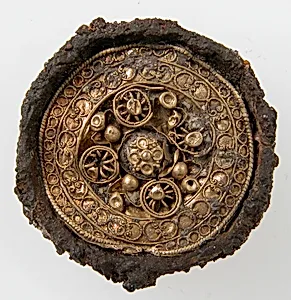
Medium
Gold, wire, iron core
Dimensions
Overall: 1 x 1/4 in. (2.5 x 0.7 cm)
Classification
Metalwork-Gold
Culture
Frankish (?)
Department
Medieval Art
Museum
Metropolitan Museum of Art, New York, NY
Credit
Gift of J. Pierpont Morgan, 1917
Accession Number
17.191.159
Rights
Public Domain
Art Historical Context
This exquisite Disk Brooch, dating to the 6th century, exemplifies masterful goldsmithing of early medieval, likely crafted within Frankish culture. Measuring just 1 x ¼ inches (2.5 x 0.7 cm), this tiny jewel was probably used to fasten cloaks or garments, serving as both a practical accessory and a symbol of. Its construction reveals sophisticated techniques: a sturdy iron core provides structural support, overlaid with shimmering gold sheets and delicate wire work, showcasing the era's advanced metalworking skills. Emerging during the Merovingian period—named after the Frankish kings who ruled much of Gaul (modern France and Germany)—such brooches reflect a fusion of Roman legacy and Germanic traditions. The Frankish (? attribution highlights uncertainties in provenance, yet underscores their prominence in post-Roman jewelry production. Gold, a precious import, signified wealth and power amid the turbulent Migration Period. Housed in the Metropolitan Museum of Art's Medieval Art Department as a gift from J. Pierpont Morgan in 1917, this brooch offers a window into everyday luxury for the elite. Its intricate design invites close inspection, reminding us how even small objects carried profound cultural weight in a world rebuilding after empire's fall.