
Disk Brooch
Unknown Artist
first half 6th century
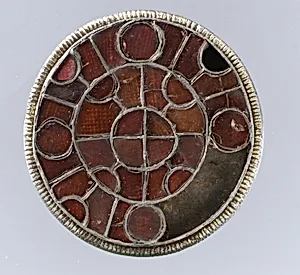
Medium
Silver-gilt, garnets with patterned foil backings.
Dimensions
Overall: 1 7/16 x 1/4 in. (3.6 x 0.6 cm)
Classification
Metalwork-Silver
Culture
Frankish
Department
Medieval Art
Museum
Metropolitan Museum of Art, New York, NY
Credit
Gift of J. Pierpont Morgan, 1917
Accession Number
17.191.38
Rights
Public Domain
Art Historical Context
This exquisite Disk Brooch, crafted by an unknown Frankish artisan in the first half of the th century, exemplifies theulent metalwork of the early Merovingian period. Measuring just 1 7/16 x 1/4 inches, this small yet striking piece was likely used to fasten cloaks or garments, serving as both a practical accessory and a symbol of status among Frankish nobility. Housed in the Metropolitan Museum of Art Medieval Art department, it entered the collection as a gift from J Pierpont Morgan in 7. The brooch's medium—silver-gilt adorned with garnets backed by patterned foil—highlights sophisticated techniques of the Migration Period. The silver base was gilded for a luxurious golden sheen, while garnets were cut and set into cells, with intricate foil underneath creating a sparkling, iridescent effect through light refraction. This cloisonné-like method, common in post-Roman barbarian jewelry, blended Germanic craftsmanship with late Roman influences, showcasing the cultural fusion in Frankish Gaul. As a rare survivor from turbulent times, the brooch offers a glimpse into daily life and artistic innovation during the decline of the Western Roman Empire, when Frankish kingdoms rose to prominence under leaders like Clovis. Its delicate beauty invites visitors to appreciate the ingenuity of early medieval jewelers.