
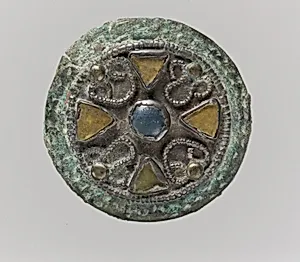
Disk Brooch
Unknown Artist
6th–7th century
Medium
Silver-gilt, blue and pale amber glass, copper alloy support (gilt?)
Dimensions
Overall: 1 1/16 x 7/16 in. (2.7 x 1.1 cm)
Classification
Metalwork-Silver
Culture
Frankish
Department
Medieval Art
Museum
Metropolitan Museum of Art, New York, NY
Credit
Gift of J. Pierpont Morgan, 1917
Accession Number
17.192.41
Rights
Public Domain
Art Historical Context
This delicate Disk Brooch, crafted by an unknown Frankish artisan in the 6th–7th century, exemplifies the exquisite metalwork of the early medieval Merovingian period. Measuring just over an inch across, it features a silver-gilt base—silver coated with a thin layer of gold for a luxurious sheen—adorned with vibrant blue and pale amber glasslays. A supporting copper alloy pin, possibly also gilt, allowed it to securely fasten cloaks or garments, serving both practical and ornamental purposes. In Frankish society, such brooches were status symbols worn by elites, reflecting wealth and craftsmanship amid the transition from late antiquity to the Middle Ages. The intricate inlay technique, known as niello or cloisonné-style glass setting, highlights skilled metalworking traditions influenced by Roman and Germanic motifs, with glass sourced from emerging trade networks. Its small scale underscores the portability of personal adornment in a warrior aristocracy. A generous gift from J. Pierpont Morgan to The Metropolitan Museum of Art in 1917, this brooch offers a tangible glimpse into daily life and artistry during Europe's formative medieval centuries, inviting us to ponder the stories of its long-ago wearer.