
Disk Brooch
Unknown Artist
ca. 550–650
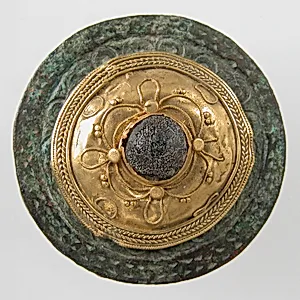
Medium
Gold on copper alloy, paste cabochon
Dimensions
Overall: 1 1/8 x 1/2 in. (2.8 x 1.2 cm)
Classification
Metalwork-Copper alloy
Culture
Frankish
Department
Medieval Art
Museum
Metropolitan Museum of Art, New York, NY
Credit
Gift of J. Pierpont Morgan, 1917
Accession Number
17.192.66
Rights
Public Domain
Art Historical Context
This exquisite Disk Brooch, crafted by an unknown Frankish artisan around 550–650 CE, the refined metalworking of the early Merovingian period in what is now France and Germany. Measuring just 1 1/8 x 1/2 inches (2.8 x 1.2 cm), this petite jewelry piece—likely used to fasten cloaks or—was a mark of status among the Frankish elite. Its disk shape, a common form in Migration Period adornments, reflects the blend of late Roman influences and emerging Germanic tastes. The brooch's medium of gold overlay on a copper alloy core, accented with paste cabochons (imitation gemstones cut in smooth, rounded domes), highlights sophisticated techniques like gilding and cloisonné-style settings. These methods allowed artisans to mimic precious stones affordably while achieving a luxurious sparkle, showcasing the Franks' mastery of metallurgy amid post-Roman economic shifts. Such pieces were not mere accessories but symbols of wealth and identity in a warrior society transitioning to Christian rule. A generous gift from J. Pierpont Morgan to The Metropolitan Museum of Art in 1917, this brooch offers a tangible glimpse into daily life and artistry during Europe's turbulent early Middle Ages, inviting us to marvel at its enduring delicacy.