
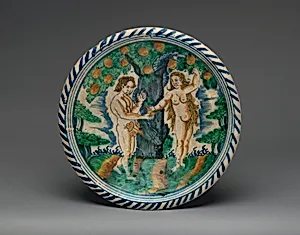
Display dish with the Temptation of Adam and Eve
Unknown Artist
ca. 1650
Medium
Delftware (tin-glazed earthenware)
Dimensions
Overall (confirmed): 2 7/8 × 14 1/4 × 14 1/4 in. (7.3 × 36.2 × 36.2 cm)
Classification
Ceramics-Pottery
Culture
British, probably London
Department
European Sculpture and Decorative Arts
Museum
Metropolitan Museum of Art, New York, NY
Credit
Robert A. Ellison Jr. Collection, Gift of Robert A. Ellison Jr., 2014
Accession Number
2014.712.1
Rights
Public Domain
Tags
Art Historical Context
This magnificent display dish, created around 1650 by an unknown British artist—likely from London—captures the timeless biblical scene of the Temptation of Adam and. Fashioned from Delftware, a tin-glazed earthenware prized for its glossy finish and vivid colors, the circular dish measures nearly 14 inches across, not for use but for prominent wall display in prosperous homes. Central to the composition are Adam and Eve amid lush trees symbolizing the Garden of Eden, a motif drawn from Genesis that warned of temptation and original sin. Delftware emerged in 17th-century England as an affordable imitation of luxury Chinese porcelain, with London workshops producing these boldly painted pieces using a tin-opacified glaze fired at low temperatures. This technique allowed for intricate narratives on large surfaces, blending religious storytelling with decorative flair during a turbulent era of civil strife and Puritan influence. Such dishes were status symbols, adorning parlors to inspire moral reflection. Today, housed in the Metropolitan Museum of Art's European Sculpture and Decorative Arts department as part of the Robert A. Ellison Jr. Collection, this dish exemplifies British ceramic innovation and the enduring cultural role of biblical imagery in everyday luxury.