
Dix Danseuses II
1925/1926
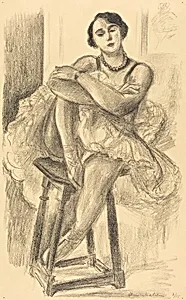
Medium
lithograph
Dimensions
sheet: 49.9 x 33.4 cm (19 5/8 x 13 1/8 in.)
Classification
Portfolio
Department
CG-W
Museum
National Gallery of Art, Washington, D.C.
Credit
Rosenwald Collection
Accession Number
1953.6.92
Rights
Public Domain
Art Historical Context
Henri Matisse's *Dix Danseuses II* (1925/1926) is a captivating lithograph from the artist's prolific printmaking phase, measuring 49.9 x 33.4 cm. Created during his time in Nice, France, this work captures ten graceful dancers in motion, echoing Matisse's lifelong fascination with dance as a symbol of rhythm, joy, and the human form. Influenced by the vibrant performances of Sergei Diaghilev's Ballets Russes, Matisse often depicted dancers to explore fluidity and energy, simplifying their figures into bold, expressive lines characteristic of his post-Fauvist style. As a lithograph—a printmaking technique where greasy crayon drawings on limestone are inked and transferred to paper—this piece highlights Matisse's mastery of the medium. Lithography allowed him to experiment with texture and repetition, producing editions that made his art more accessible. The fluid contours and economical lines convey movement with remarkable economy, distilling complex poses into harmonious compositions. Housed in the National Gallery of Art's Rosenwald Collection, part of a classified portfolio (Department CG-W), *Dix Danseuses II* exemplifies Matisse's innovative bridge between painting and print. For visitors, it offers a window into 1920s modernism, where tradition met exuberant vitality, inviting us to sway with the dancers' eternal dance.
About the Artist
Henri Matisse · 1869–1954
Henri Matisse (1869-1954) was a French painter, draughtsman, printmaker, and sculptor who is widely regarded as one of the most influential artists of the 20th century and the greatest colorist of his era. Born in Le Cateau-Cambresis in northern France, Matisse initially studied law before discovering his passion for art during a period of convalescence at age 20. He became the leading figure of F...