
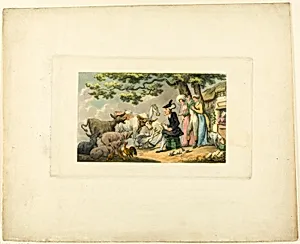
Doctor Syntax Drawing After Nature, from The Tour of Doctor Syntax
c. 1812
Medium
Hand-colored etching and acquaint on ivory wove paper
Dimensions
Image: 11 × 18.3 cm (4 3/8 × 7 1/4 in.); Plate: 15 × 25 cm (5 15/16 × 9 7/8 in.); Sheet: 29.5 × 35.7 cm (11 5/8 × 14 1/16 in.)
Classification
etching
Department
Prints and Drawings
Museum
Art Institute of Chicago
Accession Number
133372
Rights
Public Domain
Art Historical Context
Thomas Rowlandson’s *Doctor Syntax Drawing After Nature* captures a humorous moment from the popular early nineteenth-century series *The Tour of Doctor Syntax*, published around 1812. Rowlandson, a leading British caricaturist of the Regency period, collaborated with writer William Combe to illustrate the misadventures the bumbling clergyman Dr. Syntax. Here, the character is shown earnestly sketching outdoors “after nature,” a scene that gently pokes fun at amateur artists and picturesque travel while reflecting the era’s growing enthusiasm for landscape and on-the-spot observation. The print is a hand-colored etching and aquatint, a combination that allowed Rowlandson’s lively line work to be reproduced affordably and then enlivened with watercolor washes. This medium was ideal for the period’s illustrated books and satirical prints, making Rowlandson’s witty imagery widely accessible to middle-class audiences. The modest scale and crisp details invite close looking, revealing the artist’s skill at conveying both character and setting with economical strokes. Today housed in the Art Institute of Chicago’s Prints and Drawings collection, the work offers a delightful window into Regency humor and the rise of illustrated travel literature. Its enduring charm lies in Rowlandson’s affectionate satire, which continues to entertain viewers more than two centuries later.
About the Artist
Thomas Rowlandson · 1756–1827
Thomas Rowlandson (1757–1827) was an English artist and caricaturist whose satirical watercolors and prints captured the social life of Georgian Britain with unparalleled wit and technical mastery. Alongside James Gillray, he is recognized as one of the greatest British graphic artists, and his distinctive flowing line and keen observations have made his work integral to understanding late 18th an...