
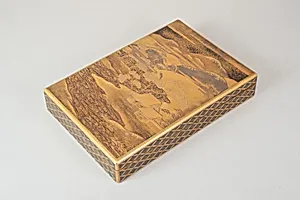
Document Box (Bunko) with Design of Cherry Trees in Bloom in Yoshino
Unknown Artist
ca. 1840
Medium
Lacquer with sprinkled gold and silver and relief lacquer (takamakie) and polished sprinkled gold and silver lacquer decoration (togidashi)
Dimensions
H. 1 7/8 in. (4.8 cm); W. 7 1/8 in. (18.1 cm); L. 10 3/8 in. (26.4 cm)
Classification
Lacquer
Culture & Period
Japan · Edo period (1615–1868)
Department
Asian Art
Museum
Metropolitan Museum of Art, New York, NY
Credit
H. O. Havemeyer Collection, Bequest of Mrs. H. O. Havemeyer, 1929
Accession Number
29.100.681
Rights
Public Domain
Tags
Art Historical Context
This exquisite Document Box (Bunko), crafted around 1840 during Japan's Edo period (16151868), showcases the era's mastery of lacquerware, a craft that flourished amid relative peace and prosperity. Measuring a compact 1⅞ × 7⅛ × 10⅜ inches, this practical yet ornate box was designed to store documents, its lid adorned with blooming cherry trees in Yoshino—a renowned mountain site celebrated in poetry and art for its spectacular spring sakura displays. Cherry blossoms, or sakura, evoke the fleeting beauty of life in Japanese culture, making this motif both decorative and philosophical. The artwork employs sophisticated lacquer techniques that highlight Edo artisans' ingenuity. Takamakie, or relief lacquer, creates raised, textured designs for the trees and branches, while togidashi—polished sprinkled gold and silver lacquer—produces a luminous, shimmering effect as metal powders are burnished to reveal intricate patterns beneath the surface. These methods transformed everyday objects into treasures, blending functionality with opulent artistry. A gift from the H.O. Havemeyer Collection to the Metropolitan Museum of Art in 1929, this bunko exemplifies Japan's enduring lacquer tradition, bridging utility and aesthetics in Asian Art. Visitors will appreciate its delicate glow, inviting reflection on nature's ephemerality.