
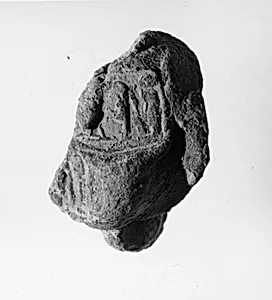
Document Sealing With Multiple Seal Impressions
Unknown Artist
ca. 1390–1352 B.C.
Medium
Mud
Dimensions
H. 2.8 cm (1 1/8 in.); w. 1.6 cm (5/8 in.); th. 1 cm (3/8 in.)
Classification
Sealing, Amenhotep III, Nebmaatre, Horus
Period
New Kingdom
Department
Egyptian Art
Museum
Metropolitan Museum of Art, New York, NY
Credit
Rogers Fund, 1911, 1912
Accession Number
12.180.734
Rights
Public Domain
Art Historical Context
This tiny mud sealing, dating to around 1390–1352 B.C. during Egypt's New Kingdom (Dynasty 18), offers a glimpse into the bustling bureaucracy of one of ancient history's greatest empires. Measuring just 2.8 cm high, it was likely used to secure important documents, such as papyrus scrolls, by pressing multiple seals into soft clay before it hardened. These impressions—visible as repeated motifs—served as a tamper-proof signature, ensuring the contents remained and authentic. Crafted from everyday mud, a humble yet practical medium, this artifact highlights the ingenuity of Egyptian administrative practices. Dynasty 18, a golden age under pharaohs like Amenhotep III and Akhenaten, saw vast trade, monumental building, and complex record-keeping. Sealings like this protected everything from tax records to royal decrees, underscoring a society where even the smallest objects enforced order and trust. Acquired through the Rogers Fund in 1911 and 1912, this unassuming piece at the Metropolitan Museum of Art reveals the unsung heroes of ancient Egypt: scribes and officials who kept the wheels of empire turning. It's a reminder that history's grandeur often hides in these modest details.