
Dog and Monkey
1814/15
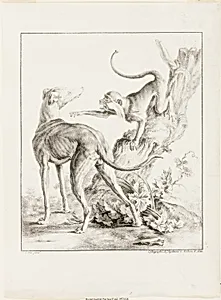
Medium
Lithograph in black on ivory wove paper
Dimensions
Image: 30.4 × 25.4 cm (12 × 10 in.); Sheet: 41.2 × 31.7 cm (16 1/4 × 12 1/2 in.)
Classification
lithograph
Department
Prints and Drawings
Museum
Art Institute of Chicago
Accession Number
39693
Rights
Public Domain
Art Historical Context
Behold the playful "Dog and Monkey," a delightful lithograph created by Gottfried Engelmann around 1814/15, now housed in the Art Institute of Chicago's Prints and Drawings collection. Measuring 30.4 × 25.4 cm (image) on a larger 41.2 × 31.7 cm sheet of ivory wove paper, this black-ink print captures two animals in what promises to be an engaging, lively encounter—hallmarks of early 19th-century naturalist whimsy. Lithography, invented just over a decade earlier by Alois Senefelder, marked a revolutionary shift in printmaking. As a pioneering German lithographer who later thrived in Paris, Engelmann helped popularize the technique, which relies on the natural repulsion of grease and water on limestone to produce fluid, drawing-like reproductions. Printed in a single bold black tone on fine wove paper, this work showcases the medium's early potential for expressive lines and tonal subtlety, bridging hand-drawn art with mass reproduction. Engelmann's piece reflects the era's fascination with animal subjects, blending scientific observation with artistic charm during the Napoleonic aftermath. As one of the artist's early efforts, it underscores lithography's role in democratizing art, making such vivid scenes accessible beyond elite painting circles. A true gem for print enthusiasts!