
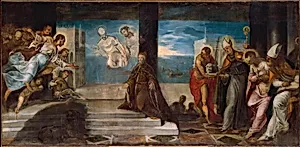
Doge Alvise Mocenigo (1507–1577) Presented to the Redeemer
probably 1577
Medium
Oil on canvas
Dimensions
38 1/4 x 78 in. (97.2 x 198.1 cm)
Classification
Paintings
Department
European Paintings
Museum
Metropolitan Museum of Art, New York, NY
Credit
John Stewart Kennedy Fund, 1910
Accession Number
10.206
Rights
Public Domain
Tags
Art Historical Context
In the grand tradition of Venetian Renaissance portraiture, Jacopo Tintoretto's *Doge Alvise Mocenigo (1507–1577) Presented to the Redeemer* (probably 1577) captures moment of pious devotion. The oil-on-canvas painting depicts Venice's Doge Alvise I Mocenigo, who ruled from 1570 his death in 1577, being presented to Christ the Redeemer—likely by Saint Mark, the city's patron saint, amid symbolic lions and ethereal angels. This horizontal composition, measuring nearly 78 inches wide, evokes the ceremonial splendor of Venice's ducal legacy. Tintoretto, a master of the Venetian Mannerist style, infuses the scene with his signature dynamism: dramatic lighting, swirling figures, and vibrant colors that heighten the spiritual drama. Oil on canvas allowed him to achieve luminous effects and rich textures, hallmarks of Venice's innovative painting techniques during the late 16th century. Created around the Doge's death, it served as a votive image, blending portraiture with religious iconography to affirm Mocenigo's faith and authority. Housed in the Metropolitan Museum of Art, this work exemplifies how Renaissance Venetians commissioned art to immortalize their leaders in heavenly company, bridging earthly power and divine grace. A testament to Tintoretto's prolific output for the city's elite, it invites visitors to ponder Venice's blend of piety, politics, and artistry.