
Domine, Quo Vadis
1592–1664
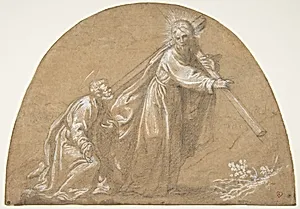
Medium
Black chalk, highlighted with white, on brown paper; cropped to the shape of a lunette
Dimensions
7-5/16 x 10-7/16 in. (18.5 x 26.5 cm)
Classification
Drawings
Department
Drawings and Prints
Museum
Metropolitan Museum of Art, New York, NY
Credit
Van Day Truex Fund, 1988
Accession Number
1988.307
Rights
Public Domain
Tags
Art Historical Context
Jacopo Vignali (1592–1664), a Florentine artist active during the Baroque era, captures a pivotal moment from Christian legend his drawing *Domine, Quo Vadis*. The title, for "Lord, where you going?", refers to apocryphal story from the Acts of Peter, where the fleeing apostle encounters Christ on the road to Rome Jesus reveals he is returning to be crucified anew, inspiring Peter to face his martyrdom. The tag "Cross" hints at this theme of sacrifice and faith, central to Counter-Reformation art that emphasized devotion and biblical drama. Executed in black chalk heightened with white on brown paper, this preparatory drawing exemplifies Vignali's mastery of chiaroscuro—dramatic light and shadow—to convey emotion and volume. Cropped to a lunette shape (a semi-circular format suited for architectural niches), it likely served as a study for a fresco or altarpiece, blending technical precision with spiritual intensity. At just 7-5/16 x 10-7/16 inches, its intimate scale invites close contemplation, showcasing the tactile qualities of chalk on toned paper popular among 17th-century Italian draftsmen. Acquired through the Van Day Truex Fund in 1988, this gem from the Metropolitan Museum of Art's Drawings and Prints department highlights Vignali's role in Tuscan Baroque draftsmanship, bridging Caravaggesque realism and Florentine elegance. A window into an artist's process, it reminds us how sketches like this fueled the grand religious narratives of the age.