
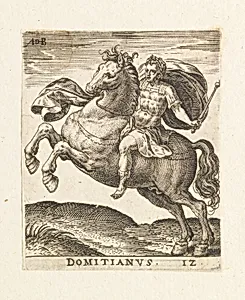
Domitianus, from "Twelve Caesars on Horseback"
ca. 1565–87
Medium
Engraving
Dimensions
Sheet: 2 5/16 × 1 7/8 in. (5.8 × 4.7 cm)
Classification
Prints
Department
Drawings and Prints
Museum
Metropolitan Museum of Art, New York, NY
Credit
The Elisha Whittelsey Collection, The Elisha Whittelsey Fund, 1951
Accession Number
51.501.7755(12)
Rights
Public Domain
Tags
Art Historical Context
Behold the dynamic engraving *Domitianus, fromTwelve Caesars on Horseback"* by Flemish artist Abraham de Bruyn, created around 1565–87. This petite print (just 2 5/16 × 1 7/8 inches) captures the Roman Emperor Domitian astride a rearing horse, evoking the grandeur of ancient imperial power. Part of a series inspired by Suetonius'sLives of the Twelve Caesars*, it reflects the Renaissance fascination with classical antiquity, blending historical reverence with equestrian drama—perfectly suiting its tags of horses and men. De Bruyn, a master engraver from Antwerp, excelled in detailed reproductive prints that popularized elite imagery during the Northern Renaissance. Engraving, a laborious intaglio technique where lines are incised into metal plates, allowed for precise, richly textured details even in this miniature format. The intricate shading and dynamic pose highlight the horse's musculature and Domitian's authoritative stance, showcasing de Bruyn's skill in conveying motion and majesty on a tiny scale. Housed in the Metropolitan Museum of Art's Drawings and Prints department, thanks to The Elisha Whittelsey Collection, this work underscores prints' role in democratizing art. It transported viewers back to Rome's turbulent era under Domitian (81–96 CE), known for his military prowess and controversial rule, making classical history vividly accessible in 16th-century Europe. A gem for history buffs and print enthusiasts alike!