
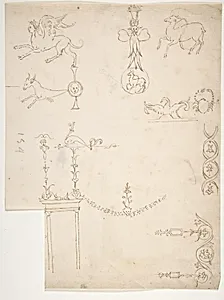
Domus Aurea, cryptoporticus, grotteschi, details (recto) blank (verso)
early to mid-16th century
Medium
Dark brown ink, black chalk, and incised lines
Dimensions
sheet: 11 1/4 x 8 1/2 in. (28.5 x 21.6 cm) 3 1/8 x 1 1/2 in. (7.9 x 3.8 cm)
Classification
Drawings|Ornament & Architecture
Department
Drawings and Prints
Museum
Metropolitan Museum of Art, New York, NY
Credit
Purchase, Rogers Fund, Joseph Pulitzer Bequest, and Mark J. Millard Gift, 1968
Accession Number
68.769.60
Rights
Public Domain
Tags
Art Historical Context
This delicate 16th-century French drawing captures intricate details of *grotteschi*—whimsical, fantastical motifs—from the cryptoporticus or covered corridor, of Rome's Domusa, Emperor Nero's lavish "Golden House" built in 64–68 CE. Created anonymously by an artist likely inspired by visits to the ancient site, the recto features precise renderings in dark brown ink and black, with incised lines suggesting it was used as a template for transfer or engraving. The verso remains blank, emphasizing its practical role in architectural ornament studies. During the early-to-mid Renaissance, European artists flocked to Rome's ruins, rediscovering buried treasures like the Domus Aurea's underground halls, whose intricate decorations revolutionized design. These *grotteschi*—intertwining figures, flora, and mythical creatures—sparked a craze, influencing Raphael's Vatican Stanze frescoes and spreading via drawings like this one to France, fueling Mannerist and ornamental arts. Housed in The Metropolitan Museum of Art's Drawings and Prints department (Purchase, Rogers Fund, Joseph Pulitzer Bequest, and Mark J. Millard Gift, 1968), this sheet (11¼ × 8½ in.) exemplifies how such sketches bridged antiquity and the modern era, preserving motifs that adorned palaces, manuscripts, and ceramics across Europe.