
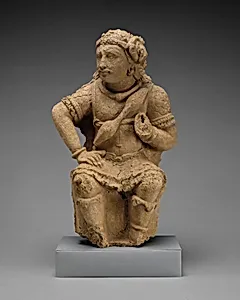
Door Guardian (Dvarapala)
Unknown Artist
ca. 4th century
Medium
Stucco
Dimensions
H. 18 in. (45.7 cm); W. 10 3/4 in. (27.3 cm)
Classification
Sculpture
Culture
Pakistan (ancient region of Gandhara)
Department
Asian Art
Museum
Metropolitan Museum of Art, New York, NY
Credit
Purchase, Friends of Asian Art Gifts, 1991
Accession Number
1991.132
Rights
Public Domain
Tags
Art Historical Context
Step through the ancient portals of Gandhara with this striking *Door Guardian (Dvarala)*, a 4th-century stucco from the region of modern-day Pakistan. Standing about 18 inches tall, this fierce protector embodies the vigilant sentinels placed at temple entrances in Buddhist and Hindu architecture. Crafted by an unknown artist, it hails from the Gandhara culture, a vibrant crossroads of artistic traditions flourishing along the Silk Road. Gandharan art, renowned for its Greco-Buddhist fusion—blending Hellenistic realism with Indian spirituality—produced masterful sculptures like this one to ward off evil spirits and safeguard sacred spaces. The Dvarapala's muscular form and authoritative stance reflect the era's emphasis on dynamic, expressive figures, often depicting wrathful deities or yakshas (nature spirits). As a stucco work, it highlights the medium's versatility: molded over an armature, painted, and detailed to mimic stone carvings, making grand temple guardians accessible for architectural niches. Acquired by the Metropolitan Museum of Art in 1991 through the Friends of Asian Art, this piece invites visitors to ponder the cultural exchanges that shaped early Buddhist iconography. Gaze upon it and feel the ancient power guarding timeless wisdom.