
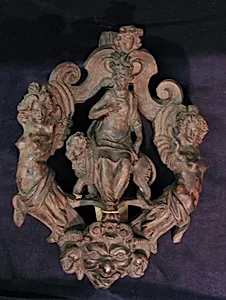
Door knocker
19th century, after 16th century original
Medium
Bronze
Dimensions
Height: 15 in. (38.1 cm)
Classification
Metalwork-Electrotype
Culture
British, after Italian original
Department
European Sculpture and Decorative Arts
Museum
Metropolitan Museum of Art, New York, NY
Credit
Gift of Henry G. Marquand, 1883
Accession Number
83.18.281
Rights
Public Domain
Tags
Art Historical Context
This exquisite bronze door knocker, a 19th-century electrotype reproduction of a 16th-century original by the renowned Italian Renaissance Jacopo Sansovino (Jacopo Tatti), captures the grandeur of Venetian Mannerism. Standing at 15 inches tall it features dynamic motifs of female nudes intertwined with powerful lions—symbols of strength and guardianship that evoke classical antiquity while showcasing Sansovino's mastery of fluid, sensual forms. Sansovino, a key figure in 16th-century Venice, blended Michelangelo's robust energy with graceful proportions, making his designs staples of elite architecture and decorative arts. Crafted as an electrotype—a innovative Victorian-era technique that electrochemically deposited copper over a mold to replicate intricate metalwork with remarkable fidelity—this British-made piece reflects 19th-century fascination with Renaissance revival. Donated to the Metropolitan Museum of Art in 1883 by Henry G. Marquand, it highlights how collectors preserved cultural treasures through accessible reproductions. Though functional as a knocker, its sculptural quality elevates it to high art, inviting visitors to appreciate the enduring allure of Renaissance bronze casting and its playful fusion of eroticism and ferocity.