
Door Knocker
Unknown Artist
15th–16th century
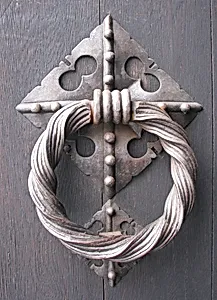
Medium
Iron
Dimensions
a: Diam. 9in. (22.9cm) a: Diam. 9 in. (22.9cm) b: H: 7 5/8in. (19.4cm); W: 7 5/8in.(19.4 cm) c: H: 3 3/4in. (9.5 cm); W: 3 3/4in. (9.5 cm) d: L: 3 1/4in. (8.3cm)
Classification
Metalwork-Iron
Culture
European
Department
The Cloisters
Museum
Metropolitan Museum of Art, New York, NY
Credit
The Cloisters Collection, 1952
Accession Number
52.121.5a–d
Rights
Public Domain
Art Historical Context
This robust iron door knocker, by an unknown European artisan in the 15th or 16th century, the functional artistry of late medieval metalwork. Comprising multiple components—including a 9-inch diameter ring (), a nearly 7¾-inch square plate (b), a smaller 3¾-inch square element (c), and a 3¼-inch length (d)—it was designed for heavy use on grand entrances. Displayed in The Cloisters at the Metropolitan Museum of Art (The Cloisters Collection,1952), it transports visitors to an era when blacksmiths transformed raw iron through heating, hammering, and shaping into enduring objects that blended utility with subtle decoration. In Renaissance-era Europe, door knockers like this served as both practical signaling devices and symbols of household status, often adorning the doors of prosperous homes, churches, or public buildings. The iron medium highlights advanced forging techniques, prized for its strength and weather resistance, allowing intricate forms to withstand centuries. Though its exact form remains a mystery without further description, such pieces reflect the transition from Gothic ornateness to Renaissance restraint, inviting us to imagine the resonant clang echoing through cobblestone streets, announcing arrivals in a vibrant, pre-industrial world.