
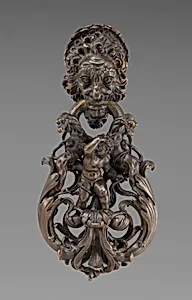
Door Knocker with Mask, Monsters and Putto
c. 1590-1600
Medium
bronze
Dimensions
overall: 28 × 13 × 7.5 cm (11 × 5 1/8 × 2 15/16 in.) height (lower portion only): 20 cm (7 7/8 in.)
Classification
Sculpture
Department
CSD
Museum
National Gallery of Art, Washington, D.C.
Credit
Gift of Robert H. Smith/Robert H. Smith Collection
Accession Number
2022.181.68
Rights
Public Domain
Art Historical Context
This exquisite bronze door knocker, in the circle of Hubert Gerhard 1590–1600, exemplifies the vibrant Mannerist style flourishing in late Renaissance Germany. Hubert Gerhard, a master sculptor at the Munich court of the Wittelsbach dukes, influenced a workshop known for intricate bronze works blending classical motifs with northern exuberance. Measuring about 28 cm tall, this functional yet fantastical piece would have adorned a grand entrance, its robust form (28 × 13 × 7.5 cm overall) designed for daily use while showcasing artistic virtuosity. At its core, a grotesque mask serves as the striking focal point, flanked by writhing monsters and a playful putto—a chubby, winged child symbolizing innocence amid chaos. These elements evoke Mannerism's love for dynamic tension, elongated forms, and mythological whimsy, cast via the sophisticated lost-wax technique that allowed fine details in bronze's warm, enduring patina. The lower portion (20 cm high) likely gripped a striker, merging utility with ornament. From the National Gallery of Art's Robert H. Smith Collection, this knocker highlights the era's cultural fusion: Roman grotesque influences met Germanic fantasy, adorning elite homes to ward off evil or impress guests. A delightful survivor of opulent princely life, it invites us to imagine the hands that grasped it centuries ago.