
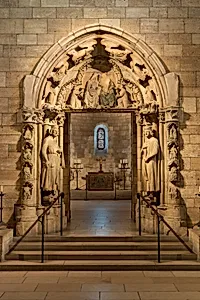
Doorway from Moutiers-Saint-Jean
Unknown Artist
ca. 1250
Medium
White oolitic limestone with traces of paint
Dimensions
15 ft. 5 in. × 12 ft. 7 in. × 55 in. (469.9 × 383.5 × 139.7 cm) Opening: 110 x 66 in. (379.4 x 167.6 cm)
Classification
Sculpture-Architectural-Stone
Culture
French
Department
The Cloisters
Museum
Metropolitan Museum of Art, New York, NY
Credit
The Cloisters Collection, 1932
Accession Number
32.147
Rights
Public Domain
Tags
Art Historical Context
Step through the grand **Doorway from Mout-Saint-Jean**, a stunning architectural sculpture hailing from a Cistercian abbey in Burgundy, France around 1250. Carved from white oolitic limestone—a durable, fine-grained stone quarried locally—this monumental portal stands over 15 feet tall, with an opening wide enough for processions. Traces of original paint reveal it was once vividly colored, a hallmark of High Gothic artistry that brought biblical scenes to life for medieval worshippers. The doorway's intricate reliefs center on the **Coronation of the Virgin**, where Christ crowns Mary amid swirling angels and attendant figures, including robed men. This theme, popular in 13th-century French sculpture, symbolizes divine triumph and Mary's role as Queen of Heaven, offering spiritual comfort in monastic settings. The fluid drapery and expressive poses reflect Gothic innovations in naturalism and emotion, transitioning from rigid Romanesque forms. Today, in The Cloisters at the Metropolitan Museum of Art (acquired 1932), this portal invites visitors to ponder medieval devotion. Its scale and symbolism transport us to an era when church doorways served as "Bible of the Poor," teaching faith through stone. A true gem of French Gothic heritage! (198 words)