
Dordrecht
Medium
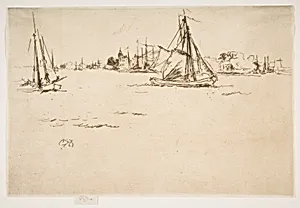
Etching and drypoint, printed in dark brown ink on fine ivory laid paper; second state of two (Glasgow)
Dimensions
Plate: 5 15/16 × 9 in. (15.1 × 22.9 cm) Sheet: 6 × 9 in. (15.2 × 22.9 cm)
Classification
Prints
Department
Drawings and Prints
Museum
Metropolitan Museum of Art, New York, NY
Credit
Harris Brisbane Dick Fund, 1917
Accession Number
17.3.129
Rights
Public Domain
Tags
Art Historical Context
James McNeill Whistler’s *Dordrecht* (1886) captures the serene harbor of Dordrecht, a historic Dutch port city, through a masterful etching and drypoint. Rendered in dark brown ink fine ivory laid paper, second state print (from the Glasgow catalogue raisonné) measures a compact 5 15/16 × 9 inches. Whistler, a leading figure in the Aesthetic movement, was renowned for prioritizing tonal harmony and atmospheric effects over literal detail, evoking the misty tranquility of boats at rest amid subtle waterways—a nod to his fascination with everyday scenes transformed into poetic impressions. The etching technique involves incising lines into a metal plate with acid for precision, while drypoint adds a soft, velvety burr from direct needle scratches, lending *Dordrecht* its rich texture and depth. Printed during Whistler’s European travels, this work reflects his innovative printmaking in the 1880s, bridging Realism and emerging Impressionism. Acquired via the Harris Brisbane Dick Fund in 1917, it resides in the Metropolitan Museum of Art’s Prints collection. Whistler’s etchings, like this one, revolutionized the medium by treating prints as autonomous artworks equal to paintings, influencing generations of artists. Visitors will appreciate how *Dordrecht* invites quiet contemplation, its boats floating in a dreamlike haze that whispers of 19th-century harbors and the artist’s pursuit of “art for art’s sake.”
About the Artist
James McNeill Whistler · 1834–1903
James Abbott McNeill Whistler (1834-1903) was an American-born painter and printmaker who became a leading figure in the Aesthetic Movement and pioneer of Tonalism and Japonisme. He revolutionized art by championing "art for art's sake" and treating paintings as visual equivalents of musical compositions, titling works as "arrangements," "harmonies," and "nocturnes" to emphasize formal qualities o...