
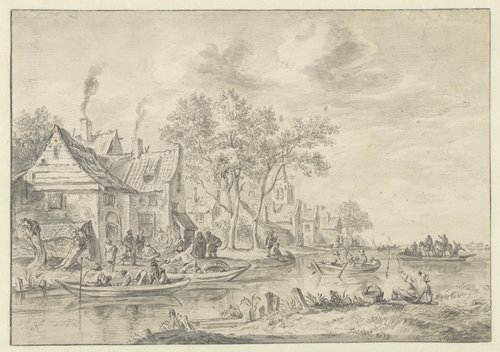
Dorp aan een rivier gelegen
1679
Medium
pen
Dimensions
274; 190
Rights
Public Domain
About this artwork
pen in grijs, zwart krijt
Art Historical Context
Created in 1679, “Dorp aan rivier gelegen” (“Village Situated on a River”) is a modest yet evocative landscape drawing by the Dutch artist Thomas Heeremans. Executed in pen with grey and black chalk on paper measuring just 190 × 274 mm, the work exemplifies the intimate scale often favored by seventeenth-century Dutch draftsmen. Such drawings frequently served both as independent works for collectors and as preparatory studies, allowing artists to record the quiet rhythms of the Dutch countryside with speed and sensitivity. Heeremans’s choice of media—fluid pen lines combined with soft chalk—creates subtle tonal contrasts that suggest light reflecting on water and the textures of village buildings and foliage. The title indicates a typical Dutch scene: a settlement nestled beside a river, a motif that resonated deeply in the Dutch Republic, where waterways shaped daily life, trade, and national identity. Though small in size, the drawing captures the era’s fascination with local topography and atmospheric effects rather than grand historical narratives. Today the sheet offers modern viewers a direct glimpse into the working methods of Golden Age landscape artists. Its restrained palette and economical technique highlight how Dutch draftsmen could distill the essence of a place with remarkable economy, inviting us to appreciate the quiet beauty of ordinary riverside life in the late seventeenth century.
About the Artist
Thomas Heeremans · 1630–1697
Painter of landscapes and panoramas; admitted to the guild in Haarlem in 1664. Comment on works: Landscapes; Canal scenes; Beach scenes