
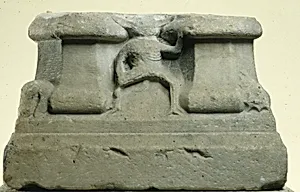
Double Column Base
Unknown Artist
late 15th century
Medium
Marble
Dimensions
Overall: 18 3/4 x 9 3/4 x 12 in. (47.6 x 24.8 x 30.5 cm)
Classification
Sculpture-Architectural
Culture
French
Department
The Cloisters
Museum
Metropolitan Museum of Art, New York, NY
Credit
Bequest of Susan Vanderpoel Clark, 1967
Accession Number
67.155.32
Rights
Public Domain
Art Historical Context
This exquisite *Double Column Base*, carved marble in late 15th-century France, exemplifies the refined architectural sculpture of the Gothic era. Measuring about 19 inches tall, this sturdy yet elegantly proportioned base was designed to support a pair of columns, likely in a grand ecclesiastical setting such as a cathedral or. The use of durable marble underscores its intended permanence, a material prized for its luminous quality and ability to capture intricate detailing under the dappled light of stained-glass windows. Crafted by an unknown artisan during France's Flamboyant Gothic period—a time of ornate innovation before the full embrace of the Renaissance—this piece reflects the era's mastery of stone carving. Subtle moldings and precise proportions reveal sophisticated stonemasonry techniques, where sculptors balanced structural function with decorative flair. Such bases formed the foundation of towering interiors, symbolizing the era's aspiration toward the divine through architecture. Housed in The Cloisters at The Metropolitan Museum of Art, thanks to the 1967 bequest of Susan Vanderpoel Clark, it offers visitors a tangible link to medieval craftsmanship. Though a modest fragment, it evokes the splendor of forgotten naves, inviting us to imagine the cathedrals where it once stood.