
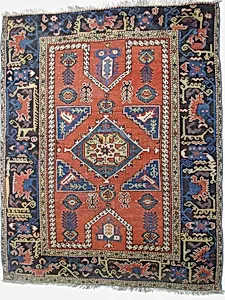
Double-Ended Bellini Carpet
Unknown Artist
probably late 18th century
Medium
Wool (warp, weft, and pile); symmetrically knotted pile
Dimensions
H. 79 3/4 in. (202.6 cm) W. 61 1/2 in. (156.2 cm)
Classification
Textiles-Rugs
Department
Islamic Art
Museum
Metropolitan Museum of Art, New York, NY
Credit
Bequest of Joseph V. McMullan, 1973
Accession Number
1974.149.26
Rights
Public Domain
Art Historical Context
Nestled in the Metropolitan Museum of Art's Department of Islamic Art, theDouble-Ended Bellini* is a captivating example of late 18th-century textile mastery. Woven from wool in warp, weft, and pile using the symmetrically knotted technique—typical of Ottoman Turkish traditions—this rug measures an impressive 79 3/4 by 61 1/2 inches (202.6 by 156.2 cm), large enough to anchor a grand room. The "double-ended" design suggests a reversible or symmetrically balanced composition, allowing the intricate patterns to shine from either orientation, a practical and aesthetic innovation for nomadic or prayer use. Bellini carpets, named for motifs echoing those in Renaissance painter Giovanni Bellini's works, highlight the cultural crossroads of the Islamic world. Produced likely in Anatolia during the Ottoman Empire's waning years, these rugs blended functionality with artistry, serving as floor coverings, mosque adornments, or symbols of status. The symmetric knotting ensured longevity and precision in rendering floral medallions, arabesques, and geometric forms, reflecting Islamic aniconism and mathematical harmony. A generous bequest from Joseph V. McMullan in 1973 brings this heirloom to life, inviting us to trace threads of history through every knot. Marvel at how such handwoven wonders transported wealth and piety across centuries!