
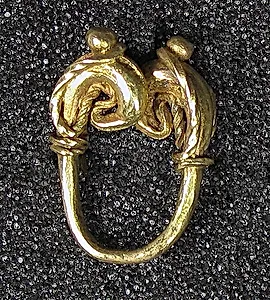
Double Scroll Fertility Earring
Unknown Artist
8th–12th century
Medium
Gold
Dimensions
H. 15/16 in. (2.4 cm)
Classification
Jewelry
Culture
Indonesia (Central Java)
Department
Asian Art
Museum
Metropolitan Museum of Art, New York, NY
Credit
Gift of the Eilenberg-Rosen Partnership, 2001
Accession Number
2001.794.181
Rights
Public Domain
Art Historical Context
This delicate **Double Scroll Fertility Earring crafted from gleaming gold in Central Java, Indonesia, dates to the 8th–12th century—a golden era of Hindu-Buddhist kingdoms the Sailendras and Matarams. Measuring just 15/16 inch (2.4 cm) high, this tiny jewel exemplifies the exquisite metalworking skills of ancient Javanese artisans, who transformed precious gold into intricate adornments worn by elites. The double scroll motif, evoking swirling vines or serpentine forms, likely symbolized fertility and abundance, central themes in Southeast Asian cosmology tied to rice agriculture and divine prosperity. Gold's use here was no accident; as a rare, enduring metal, it signified wealth, spiritual purity, and protection against malevolent forces. Such earrings, often paired, would have dangled from pierced ears, accentuating the wearer's status during rituals or daily life. Though the artist remains unknown, the piece reflects broader artistic traditions of the region, where jewelry bridged the mundane and sacred. Now at The Metropolitan Museum of Art (gift of the Eilenberg-Rosen Partnership, 2001), this earring invites us to ponder the intimate role of adornment in ancient Javanese society—small in scale, yet profound in cultural resonance.