
Double-Sided Comb
Unknown Artist
7th century
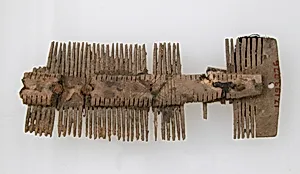
Medium
Bone, iron pins
Dimensions
Overall: 3 3/8 x 1 5/16 x 5/16 in. (8.5 x 3.3 x 0.8 cm)
Classification
Bone
Culture
Frankish
Department
Medieval Art
Museum
Metropolitan Museum of Art, New York, NY
Credit
Gift of J. Pierpont Morgan, 1917
Accession Number
17.193.226
Rights
Public Domain
Art Historical Context
Step into the daily life of 7th-century Frankish society with this exquisite double-sided comb a humble yet revealing artifact from the early medieval world. Crafted from bone iron pins, it measures a compact 3 3/8 x 1 5/16 x 5/16 inches, perfectly pocket-sized for personal grooming. The double-sided design—typically one coarse edge for detangling and removing lice, the other finer for smoothing hair—highlights practical ingenuity in an era before modern tools. Originating from the Frankish culture, which dominated much of Western Europe during the Merovingian dynasty, this comb offers a glimpse into the material world of post-Roman Gaul. Bone, a readily available and workable medium, was often carved with precision, showcasing the skilled craftsmanship of anonymous artisans. Such objects were not mere utilities; they reflected status and hygiene standards among the Frankish elite and common folk alike. Now housed in the Metropolitan Museum of Art's Medieval Art Department, thanks to a 1917 gift from J. Pierpont Morgan, this comb bridges the gap between everyday utility and historical treasure. It reminds us how small personal items illuminate the textures of ancient lives, blending function with subtle artistry.