
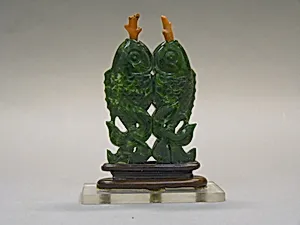
Double Snuff Bottle
Unknown Artist
19th century
Medium
Chloromelanite jadeite with coral stoppers; wood stand
Dimensions
H. 2 7/8 in. (7.3 cm)
Classification
Snuff Bottles
Culture & Period
China · Qing dynasty (1644–1911)
Department
Asian Art
Museum
Metropolitan Museum of Art, New York, NY
Credit
Bequest of Edmund C. Converse, 1921
Accession Number
21.175.168
Rights
Public Domain
Tags
Art Historical Context
This exquisite **Double Snuff Bottle** China's Qing dynasty (16441911), dating to the 19th, exemplifies the refined artistry of snuff bottles—small, portable containers for tobacco introduced by Europeans in the 17th century. Highly prized by scholars, officials, and collectors, these bottles became a canvas for miniature masterpieces, symbolizing status and connoisseurship. Crafted by an unknown artist, this rare double-chambered example stands just 2 7/8 inches (7.3 cm) tall, perfect for tucking into a sleeve. Carved from chloromelanite jadeite—a lustrous, dark green-to-black variety of jade revered in Chinese culture for its rarity and imperial associations—the bottle features coral stoppers and rests on a fitted wood stand. Delicate fish motifs, likely symbolizing abundance, harmony, and good fortune (as fish or *yu* evoke "surplus" in Chinese), adorn its surface, showcasing masterful low-relief carving techniques that highlight the stone's natural translucency and depth. Housed in the Metropolitan Museum of Art's Asian Art Department through the 1921 bequest of Edmund C. Converse, this piece reflects the Qing era's peak in jade craftsmanship and the global allure of Chinese luxury arts. Visitors, imagine a Qing gentleman admiring its subtle glow by candlelight—a testament to elegance in everyday ritual.