
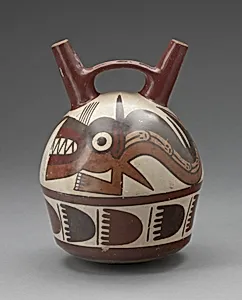
Double Spout Vessel Depicting an Abstract Shark with Human Attributes
180 BCE–500 CE
Medium
Ceramic and pigment
Dimensions
17.2 × 12.7 cm (6 13/16 × 5 in.)
Classification
earthenware
Department
Arts of the Americas
Museum
Art Institute of Chicago
Accession Number
91376
Rights
Public Domain
Art Historical Context
This striking Double Spout Vessel from the Nasca culture (180 BCE500 CE) showcases the ingenuity of ancient Peruvian potters from the south coast. Crafted from earthenware ceramic and adorned with vibrant pigments, the 17.2 × 12.7 cm vessel features an abstract shark with human-like attributes—elongated limbs, expressive eyes, and a humanoid torso—evoking a supernatural being from Nasca mythology. The double-spout design a hallmark of Nasca pottery, allowed for pouring liquids like chicha (fermented corn beer) without spilling, blending practicality with ritual function. Nasca ceramics, produced during a time of agricultural innovation and massive geoglyphs like the Nazca Lines, often depicted hybrid creatures symbolizing transformation, fertility, and the spirit world. This piece reflects the culture's animistic worldview, where animals embodied powerful forces or deities, possibly linked to maritime lore given the shark motif. Artistically, the vessel demonstrates masterful modeling and slip-painting techniques, with post-fired pigments ensuring color durability. Housed in the Art Institute of Chicago's Arts of the Americas department, it invites visitors to ponder the Nasca's blend of whimsy and profound cosmology in everyday objects turned art.
About the Artist
Nasca
Nasca artists, active from approximately 100 BCE to 800 CE along the arid southern coast of Peru in the Rio Grande de Nazca and Ica Valleys, produced some of the most vibrant and technically innovative art of the ancient Americas. Their work emerged from the Paracas tradition, expanding on earlier resin-painted ceramics and complex textiles while introducing pre-fire slip painting in up to twelve ...