
Douer (Dover)
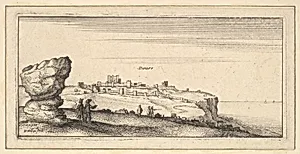
Medium
Etching; first state of two
Dimensions
Plate: 2 7/16 × 5 3/16 in. (6.2 × 13.2 cm) Sheet: 2 11/16 × 5 9/16 in. (6.9 × 14.2 cm)
Classification
Prints
Department
Drawings and Prints
Museum
Metropolitan Museum of Art, New York, NY
Credit
Harris Brisbane Dick Fund, 1917
Accession Number
17.3.3119
Rights
Public Domain
Tags
Art Historical Context
Wenceslaus Hollar’s 1642 etching *Douer (Dover)* captures a sweeping view of the English port town and its imposing castle perched above the cliffs. Created shortly after the Bohemian-born artist settled in England, the print exemplifies Hollar’s meticulous topographical style, in which fine etched lines record architecture, terrain, and atmosphere with remarkable clarity. As the first state of two, this impression preserves the artist’s initial vision before later revisions. Etching proved ideal for such documentary work, allowing Hollar to produce affordable, widely circulated images that introduced distant viewers to notable British sites. In 1642, the year civil war erupted, views like this also served as quiet records of a nation on the brink of profound change. The small plate size—barely five inches wide—belies the wealth of detail Hollar achieved, inviting close inspection of the castle’s towers and the bustling harbor below. Today the print resides in the Metropolitan Museum’s collection of drawings and prints, where it continues to illustrate both Hollar’s technical mastery and the enduring appeal of topographical art.
About the Artist
Wenceslaus Hollar · 1607–1677
Wenceslaus Hollar (1607-1677) was a prolific Bohemian etcher who became one of the most accomplished printmakers of the seventeenth century. Born in Prague, he trained under Matthäus Merian in Frankfurt before entering the service of Thomas Howard, Earl of Arundel, in 1636. Hollar spent most of his career in England, where he produced approximately 2,740 etchings documenting an extraordinary range...