
Doves of Pliny
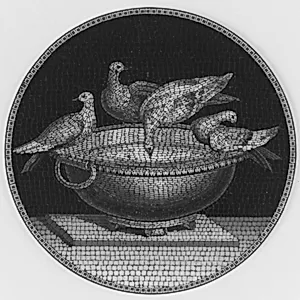
Medium
Glass mosaic on bronze
Dimensions
Diameter: 4 3/4 in. (12.1 cm)
Classification
Glass
Culture
Italian, Rome
Department
European Sculpture and Decorative Arts
Museum
Metropolitan Museum of Art, New York, NY
Credit
Purchase, Gifts of Dr. and Mrs. A.L. Garbat and Irwin Untermyer, by exchange, 1982
Accession Number
1982.22
Rights
Public Domain
Tags
Art Historical Context
In the late 18th century, artist Giacomo Raffaelli the art of micromosaic, creating exquisite miniature replicas of ancient Roman treasures for Grand Tour travelers visiting Rome. His *Doves of Pliny* (1783), a glass mosaic on bronze just 4 3/4 inches in, captures the serene beauty of a famed antiquity: a pair of doves delicately drinking from a basin, perched on its rim. This design echoes Pliny the Elder's description in *Natural History* of a mosaic from Emperor Augustus's Portico of Adonis, though it draws directly from a well-preserved version unearthed in Pompeii's House of the Faun. Raffaelli's neoclassical work exemplifies the micromosaic technique, where thousands of tiny glass tesserae—some as small as a grain of sand—are meticulously cut and arranged to mimic painting's illusionistic depth and color gradation. Mounted on bronze for durability and elegance, it served as both a scholarly souvenir and a marvel of craftsmanship, bridging antiquity and the Enlightenment's fascination with classical revival. Housed in the Metropolitan Museum of Art's European Sculpture and Decorative Arts collection, this piece invites us to ponder the doves' timeless grace amid Rome's enduring legacy.