
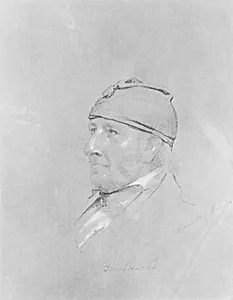
Dr. Bracht
Eastman Johnson, 1851
About this artwork
**Dr. Bracht** (1851) by Eastman Johnson is a compelling portrait drawing that captures the artist's early mastery of realism. Created when Johnson was in his late 20s, during his formative years studying in Europe—particularly in Düsseldorf and The Hague—this work exemplifies his transition from crayon portraits in the U.S. to more refined European-influenced techniques. The, Dr. Bracht, likely a figure from Johnson's Düsseldorf circle, is rendered with intimate detail, highlighting Johnson's rising prominence as a chronicler of American and European life before he became renowned for genre scenes of rural America. Executed in graphite and white chalk on brown wove paper (14 1/4 x 10 5/8 in.), the medium allows for dramatic tonal contrasts: the brown paper serves as a mid-tone base, graphite builds shadows and contours, and white chalk adds luminous highlights to the face and clothing. This versatile technique was popular among 19th-century draftsmen for its speed and expressiveness, often used for studies that informed oil paintings. Housed in The Metropolitan Museum of Art's American Wing, it reflects Johnson's pivotal role in American realism, bridging Old World precision with New World subjects. A gift from Thomas Colville in memory of Stephen D. Rubin (1991), this intimate portrait invites visitors to appreciate the quiet power of preparatory sketches in an artist's oeuvre.