
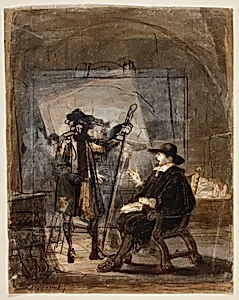
Dr. Nicholas Tulp in Rembrandt's Studio (recto); Scene from Rembrandt's Life (?) (verso)
Medium
Pen and brown ink with brush and gray and brown wash and white gouache, over graphite, with scraping (recto), and pen and brown ink with brush and brown and gray wash, over red chalk and graphite (verso), on ivory laid paper
Dimensions
23.9 × 19.2 cm (9 7/16 × 7 9/16 in.)
Classification
watercolor
Department
Prints and Drawings
Museum
Art Institute of Chicago
Accession Number
114127
Rights
Public Domain
Art Historical Context
Step into the imaginative world of 19th Dutch artist Jacobus Ludus Cornet with this captivating double-sided drawing from 1846, housed in the Art Institute of Chicago's and Drawings collection. On the recto, Cornet depicts *Dr. Nicholas Tulp Rembrandt's Studio*, ev the famed anatomist from Rembrandt's iconic 1632 group portrait *The Anatomy Lesson of Dr Nicolaes Tulp*. verso features a tentative *Scene from Rembrandt's Life blending historical homage with creative fancy during a era of Romantic revival for the 17th-century master's legacy. Crafted on ivory laid paper (23.9 × 19.2 cm), the recto employs pen and brown ink with brush and gray/brown washes, white gouache over graphite, and scraping for dramatic highlights and textures—techniques that mimic Rembrandt's own chiaroscuro effects. The verso adds red chalk beneath similar ink and washes, showcasing Cornet's virtuosic command of mixed media classified here as watercolor. These methods create depth and luminosity on a small scale, inviting viewers to ponder Rembrandt's creative process amid 1840s nostalgia for Golden Age artists. This gem reflects mid-19th-century Europe's fascination with Rembrandt's life and work, as artists like Cornet reimagined his world to bridge past and present, offering a window into artistic inspiration.
About the Artist
Jacobus Ludovicus Cornet · 1815–1882
Jacobus Ludovicus Cornet (1815–1882) was a Dutch painter, draughtsman, and museum curator whose career bridged artistic practice and cultural preservation. Born in Leiden in 1815, Cornet devoted his life to documenting Dutch history and culture through his paintings and drawings while simultaneously working to preserve the nation's artistic heritage as head of Leiden's Prentenkabinet (Prints Cabin...