
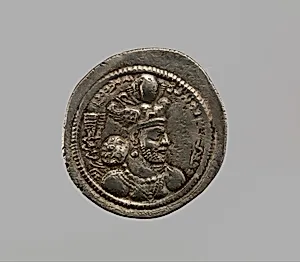
Drachm of Bahram IV
Unknown Artist
ca. 388–99 CE
Medium
Silver
Dimensions
Thickness 0.15 cm, Diameter 2.45 cm
Classification
Metalwork-Coins-Inscribed
Culture & Period
Sasanian · Sasanian
Department
Ancient Near Eastern Art
Museum
Metropolitan Museum of Art, New York, NY
Credit
Bequest of Joseph H. Durkee, 1898
Accession Number
99.35.2965
Rights
Public Domain
Tags
Art Historical Context
This exquisite silver drachm, minted during the reign of Sasanian king Bahram (ca. 388–399 CE), a glimpse into the grandeur of the Sasanian, which flourished in ancient Iran from 224 to 651 CE. As a standard unit of currency, the drachm trade across the Near East and served as royal propaganda, proclaiming the king's authority through its imagery. At just 2.45 cm in diameter and 0. cm thick, this delicate coin—struck from high-quality silver—fits easily in the palm, yet it embodies the power of an empire that rivaled Rome. The obverse likely features a dignified bust of Bahram IV, adorned in the characteristic Sasanian royal attire, with tags highlighting its focus on kings and male figures. Inscribed in Pahlavi script, these coins standardized royal portraits across the realm, blending artistic precision with symbolic motifs like fire altars on the reverse, evoking Zoroastrian piety and imperial might. Such metalwork techniques—using engraved dies to strike intricate details—demonstrate advanced Sasanian minting prowess, ensuring uniformity and authenticity. Bequeathed to the Metropolitan Museum of Art in 1898 by Joseph H. Durkee, this coin from the Ancient Near Eastern Art department invites us to ponder Bahram IV's turbulent rule amid succession struggles, preserving a tangible link to a pivotal era of Persian history.