
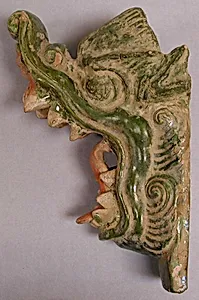
遼 綠釉瓷龍首|Dragon head with open mouth
Unknown Artist
Medium
Stoneware with colored glazes
Dimensions
H. 4 3/4 in. (12.1 cm); L. 6 7/8 in. (17.5 cm)
Classification
Ceramics
Culture & Period
China · Liao dynasty (907–1125)
Department
Asian Art
Museum
Metropolitan Museum of Art, New York, NY
Credit
Charlotte C. and John C. Weber Collection, Gift of Charlotte C. and John C. Weber, 1994
Accession Number
1994.605.49
Rights
Public Domain
Tags
Art Historical Context
This exquisite dragon head, crafted during China's Liao dynasty (907–5), captures the fierce of one of the most revered symbols in East Asian culture. Measuring just 4¾ inches high and 6⅞ inches long, this stoneware piece features an open-mouthed dragon with vivid green glaze, evoking the mythical beast's raw power and vitality. Produced by an unknown artisan, it hails from the Khitan-led Liao empire, a period blending nomadic traditions with sophisticated Chinese influences in the north. Liao ceramics are celebrated for their innovative use of colored glazes over stoneware, often in dynamic greens, browns, and creams, marking a continuation of Tang dynasty polychrome techniques while introducing bolder, more expressive forms. Dragons like this one symbolized imperial authority, protection, and cosmic forces, frequently adorning architectural elements, ritual objects, and elite furnishings. This small yet imposing sculptural fragment likely served a decorative or ceremonial purpose, reflecting the Liao court's fascination with supernatural motifs amid their expansive rule over steppe and agrarian lands. Today, housed in the Metropolitan Museum of Art's Asian Art Department as a gift from the Charlotte C. and John C. Weber Collection (1994), it offers a window into a lesser-known dynasty's artistic prowess, reminding us how everyday materials could embody eternal myths.