
Dragon Robe
Unknown Artist
18th century
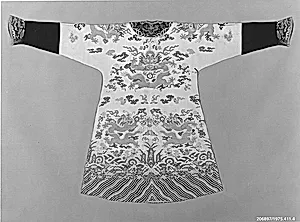
Medium
Silk
Dimensions
55 in. (139.7 cm)
Classification
Costumes-Woven
Culture & Period
China · Qing dynasty (1644–1911), Kangxi period (1662–1722)
Department
Asian Art
Museum
Metropolitan Museum of Art, New York, NY
Credit
Gift of Mr. Stanley Marcus, Neiman-Marcus and Baron W. Langer von Langendorff, Evyan Perfumes, Inc., 1975
Accession Number
1975.411.4
Rights
Public Domain
Tags
Art Historical Context
Step into the imperial splendor of Qing dynasty China with this exquisite *Dragon Robe*, a masterpiece from the Kangxi period (16621722). Crafted the 18th century an unknown artist, this woven costume measures 55 inches139.7 cm) in length, embodying the opulence of one of China's most enduring dynasties. Displayed in the Metropolitan Museum of Art's Asian Art Department, it was generously gifted in 1975 Mr. Stanley Marcus of Neiman-Marcus, Baron W. Langer von Langendor, and Evyan Perf, Inc. Dragon robes like this were reserved for the emperor and high-ranking officials, symbolizing supreme authority and cosmic harmony. The dragon motif—five-clawed for imperial use—represents power, good fortune, and the emperor's divine mandate to rule, weaving mythology into the fabric of governance. During the Kangxi era, under the reign of the enlightened Emperor Kangxi, such garments reflected the dynasty's cultural zenith, blending Manchu and Han Chinese traditions. Artistically, the robe showcases masterful silk weaving techniques, where intricate patterns of dragons likely coil across waves and clouds, achieved through labor-intensive looms. This classification as a woven costume highlights the technical prowess of anonymous artisans, whose work preserved cultural prestige amid political transformation. A true treasure, it invites us to envision the pageantry of forbidden cities long past.