
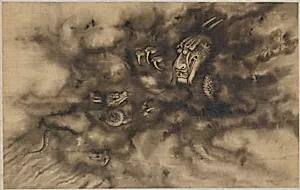
Dragons in clouds
Classification
Painting
Department
Smithsonian Collection
Museum
Smithsonian American Art Museum
Credit
Gift of Charles Lang Freer
Accession Number
F1909.378a-h
Rights
Public Domain
Tags
About this artwork
To 1909
Art Historical Context
"Dragons in Clouds" is a captivating painting by Zhou Xun (1649-1729), created in 1684 during China's Qing dynasty (1644-1911). This work exemplifies traditional Chinese art, where sinuous dragons emerge from swirling mists, embodying power, auspiciousness, and imperial might. Dragons were potent symbols in Chinese culture, often associated with the emperor and the heavens making this motif a favorite in courtly and scholarly painting. As a Qing-era piece, the artwork reflects the dynasty's artistic flourishing, blending meticulous brushwork with imaginative compositions typical of literati painters. Though the exact medium is unknown, such paintings were commonly executed in ink and light colors on silk or paper, allowing ethereal effects that evoke the dragons' mythical vitality amid turbulent clouds. Acquired by collector Charles Lang Freer before 1909, it entered the Smithsonian Collection as a gift, now housed at the Smithsonian American Art Museum. This piece highlights Freer's passion for Asian art and offers visitors a window into Qing aesthetics, where nature and mythology intertwine to convey harmony and cosmic order.