
Draped Figure, Standing
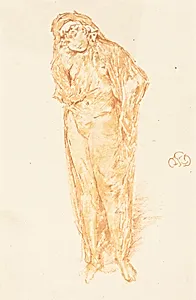
Medium
lithograph in orange on laid paper
Dimensions
image: 22.7 × 11.2 cm (8 15/16 × 4 7/16 in.) sheet: 27.7 × 20.1 cm (10 7/8 × 7 15/16 in.)
Classification
Department
CG-W
Museum
National Gallery of Art, Washington, D.C.
Credit
Rosenwald Collection
Accession Number
1943.3.8799
Rights
Public Domain
Art Historical Context
James McNeill Whistler’s *Draped Figure, Standing* (1891) is a delicate lithograph in warm orange ink on laid paper, capturing a poised, anonymous figure enveloped in flowing drapery. Measuring just 22.7 × 11.2 cm, this intimate print exemplifies Whistler’s late-career mastery of lithography, a medium he championed to rival painting in subtlety and tone. The soft, velvety lines and subtle gradations evoke a sense of ethereal grace, inviting viewers to contemplate form and shadow rather than narrative detail. As a leader of the Aesthetic movement, Whistler believed art should prioritize beauty and harmony—“art for art’s sake”—and this work reflects that philosophy. Created during a period when he experimented boldly with printmaking after his famous 1870s oil paintings like *Arrangement in Grey and Black No.1* (Whistler’s Mother), the lithograph showcases his innovative transfer technique. By drawing on transfer paper and printing in a single, luminous color, Whistler achieved painterly effects impossible in earlier black-and-white prints, influencing modern graphic arts. Housed in the National Gallery of Art’s Rosenwald Collection, this piece highlights Whistler’s enduring impact on 19th-century print culture. Its modest scale belies its significance: a quiet study in elegance that rewards close inspection, much like a whispered secret in a grand gallery.
About the Artist
James McNeill Whistler · 1834–1903
James Abbott McNeill Whistler (1834-1903) was an American-born painter and printmaker who became a leading figure in the Aesthetic Movement and pioneer of Tonalism and Japonisme. He revolutionized art by championing "art for art's sake" and treating paintings as visual equivalents of musical compositions, titling works as "arrangements," "harmonies," and "nocturnes" to emphasize formal qualities o...